Most landscape lighting weather damage in Middle Tennessee builds slowly. Freeze and thaw walk stake-mounted fixtures off their aim, humid soil corrodes connections that were never properly sealed, mulch and new growth bury lenses and block beams, and a storm surge can take out a transformer. Only that last one tends to happen overnight.
Because it builds slowly, weather damage is easy to miss. The usual sign is a system that looks dimmer and patchier than it did last year, or one run that drops out after rain and comes back the next day. The faults we see most in landscape lighting repair across Greater Nashville are failed transformers, corroded connections, cut cable, water ingress and fixtures at end of life. Weather has a hand in several of those. It causes some outright, and it finishes off joints that were already weak.
What does freeze and thaw do to landscape lights?
It knocks stake-mounted lights out of aim. Soil that freezes and thaws over and over through a Middle Tennessee winter heaves and settles, and path and area lights on stakes move with it. The shift is small each time, but over one winter it adds up to enough to swing a path light off the walk and onto the lawn.
The fixture still works. It is just pointed at the wrong thing, which is why winter damage often gets mistaken for a design problem.
Splices buried close to the surface ride the same movement. A well-made, sealed joint takes it in stride. A marginal one, like a twist-and-tape splice, is more likely to pull loose after a hard winter than after a mild one.
Why does summer humidity ruin finishes and connections?
Humidity is slower. Above ground it goes after the finish. Painted aluminum looks fine on install day, then moisture gets under the coating and it starts to blister and flake. That is why the systems we design use solid brass and copper instead. Middle Tennessee humidity and freeze-thaw cycles punish any coating, and solid metal has no coating to lose.
Below ground it goes after connections. A connector that was never properly sealed, or a taped splice sitting in a damp bed, corrodes from the inside where nobody can see it. It can run for months before anything shows. When faults do start, they come and go with the weather: a run drops out after rain, then works perfectly on the dry afternoon someone comes out to look at it. Beds that stay wet, such as the low side of a slope, are also where water gets into fixtures themselves. We re-make failed joints with properly rated waterproof connectors instead of patching them, because a patched connection in wet soil is a callback with a date already attached.
What happens to the transformer in a storm?
Of everything in a low-voltage system, only the transformer plugs into household power. Whatever hits that circuit in a storm hits the transformer too. A nearby lightning strike or a surge on the grid can kill it while every fixture and foot of cable downstream comes through fine.
When a whole system goes dark right after a storm, start at the transformer end. Check that the GFCI outlet it plugs into hasn’t tripped and that the timer didn’t lose its schedule in a power cut. Both are covered in the homeowner checks for a system that’s partly or fully dark. If those are fine, the transformer needs testing. The fault has to be found before anyone can price fixing it, so a repair is quoted after the system is tested.
Wind does its damage above ground. Limbs come down on fixtures, and a hard rain can wash mulch off cable that was buried shallow, leaving it where the next mower or edger will find it.
How do roots, mulch and new growth get in the way?
Roots rarely cut cable. What they do is lift and shift the soil around them as a tree matures, so a run laid near a young tree gets stretched and strained over years, along with any splice on it.
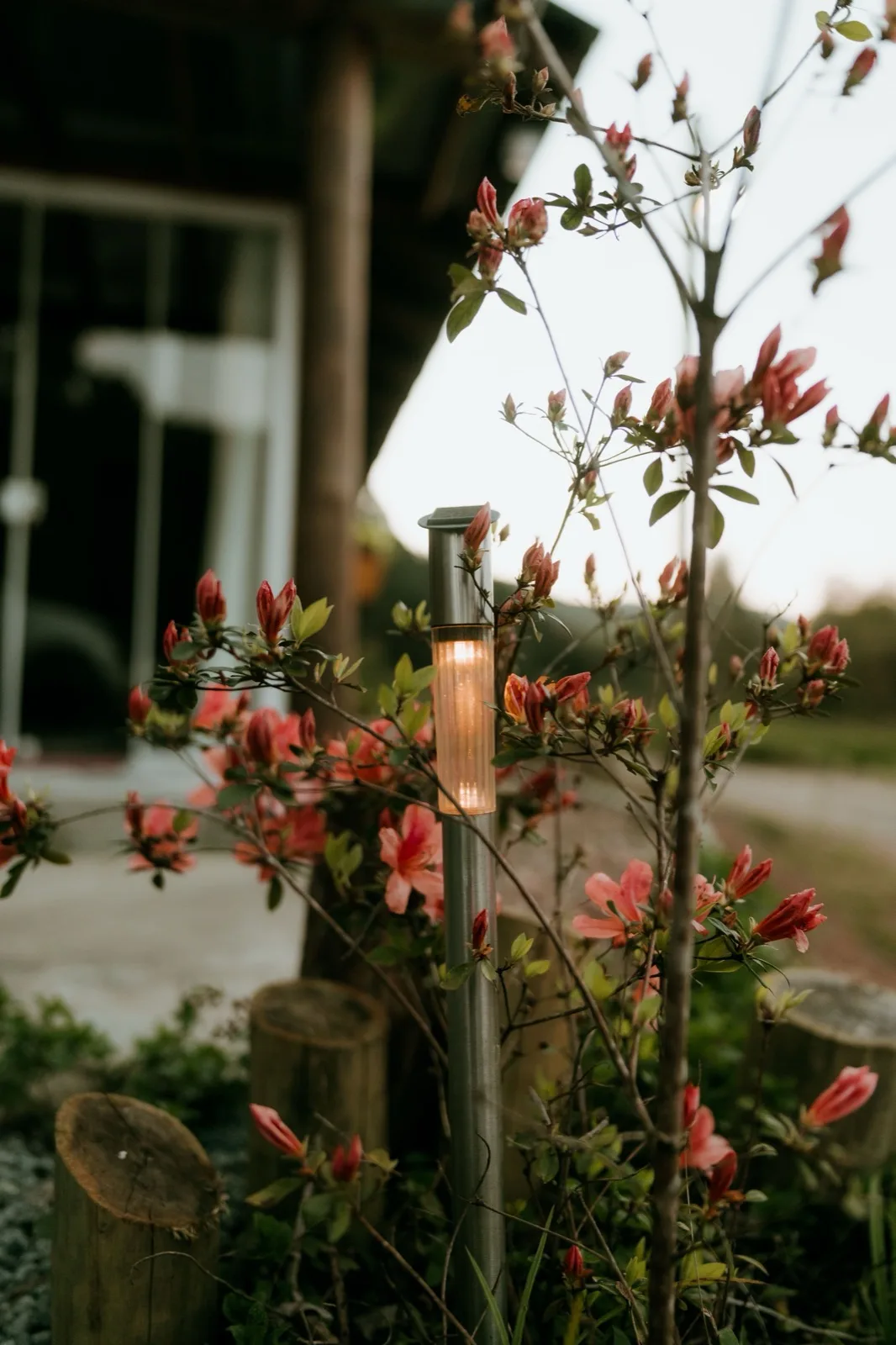
Mulch and plants cause a quieter problem. Each fresh top-up of mulch can bury a low fixture a little deeper, lenses silt over, and by midsummer a shrub that was clear of the beam in spring is standing in front of it. Garden and bed lighting takes the worst of this, since it sits right among the plants doing the growing. Strictly speaking none of it is a failure. But a light buried under mulch looks exactly like a dead one, so dig it out before calling anyone.
What should you check after each season?
None of this needs tools, just a walk around the property at dusk once a season. Most of what turns up gets fixed by re-aiming a light or clearing a lens.
- Late winter: re-aim anything the freeze has walked off target, and look at splices in the wettest part of each bed.
- Spring into summer: clear pollen and mulch off lenses. Note any light that only misbehaves after rain, because that points to a connection starting to corrode.
- After a serious storm: GFCI and timer first, then limbs on fixtures and any cable the rain uncovered.
- Fall: cut the season’s growth back from in front of beams, and check the runs anywhere there was digging, planting or edging over the summer.
If you would rather hand that walk off, that is what our lighting maintenance and repair service is for. For the faults that have nothing to do with weather, the outdoor lighting repair guide covers the rest.
Common questions
Does freezing weather damage buried lighting cable?
Cold on its own is not the problem for buried lighting cable. The trouble is the ground moving around it. Freeze and thaw heave and settle the soil, and that tugs at splices and connections along the run. A winter fault usually traces back to a joint rather than to the cable itself.
That’s why a run with properly sealed connectors gets through a Middle Tennessee winter fine.
Can tree roots break landscape lighting wire?
Rarely by cutting it. Roots work slowly. As a tree matures, its root system lifts and shifts the soil the cable lies in, stretching the run and straining any nearby splice over years rather than in one event. The risk is strain, not a cut.
If a fixture close to a tree that has grown a lot since installation starts flickering or dropping out, the cable and joints near that tree are the first place to look.
Should landscape lighting be turned off in winter?
No. A low-voltage system is built to run outdoors all year, and switching it off protects nothing, because freeze-thaw damage comes from the ground moving, not from power in the wires. Leaving it on through winter actually helps. You will notice a fixture drifting off aim in January instead of finding it in spring.
Can lightning or a power surge damage a transformer?
Yes. The transformer plugs into household power, so a nearby strike or a grid surge can reach it the same way it reaches anything else on that circuit. It can fail while the fixtures and cable downstream come through fine.
If the whole system goes dark right after a storm, check the GFCI outlet and the timer first, then have the transformer tested before assuming the damage goes further.