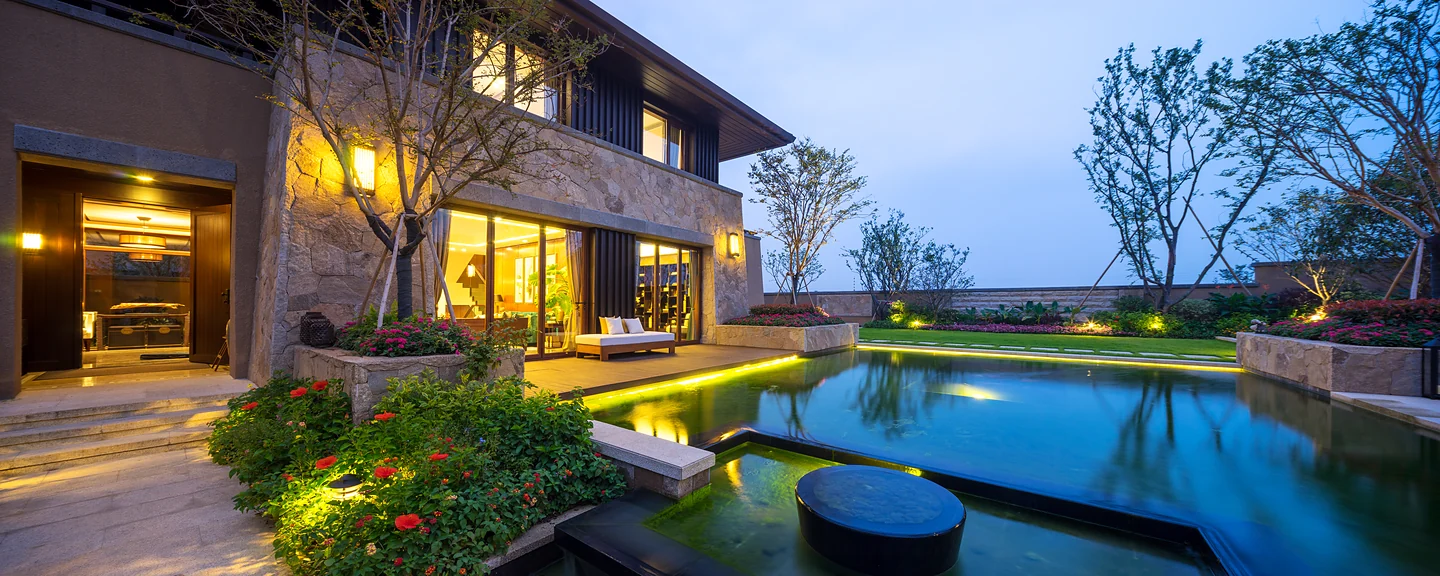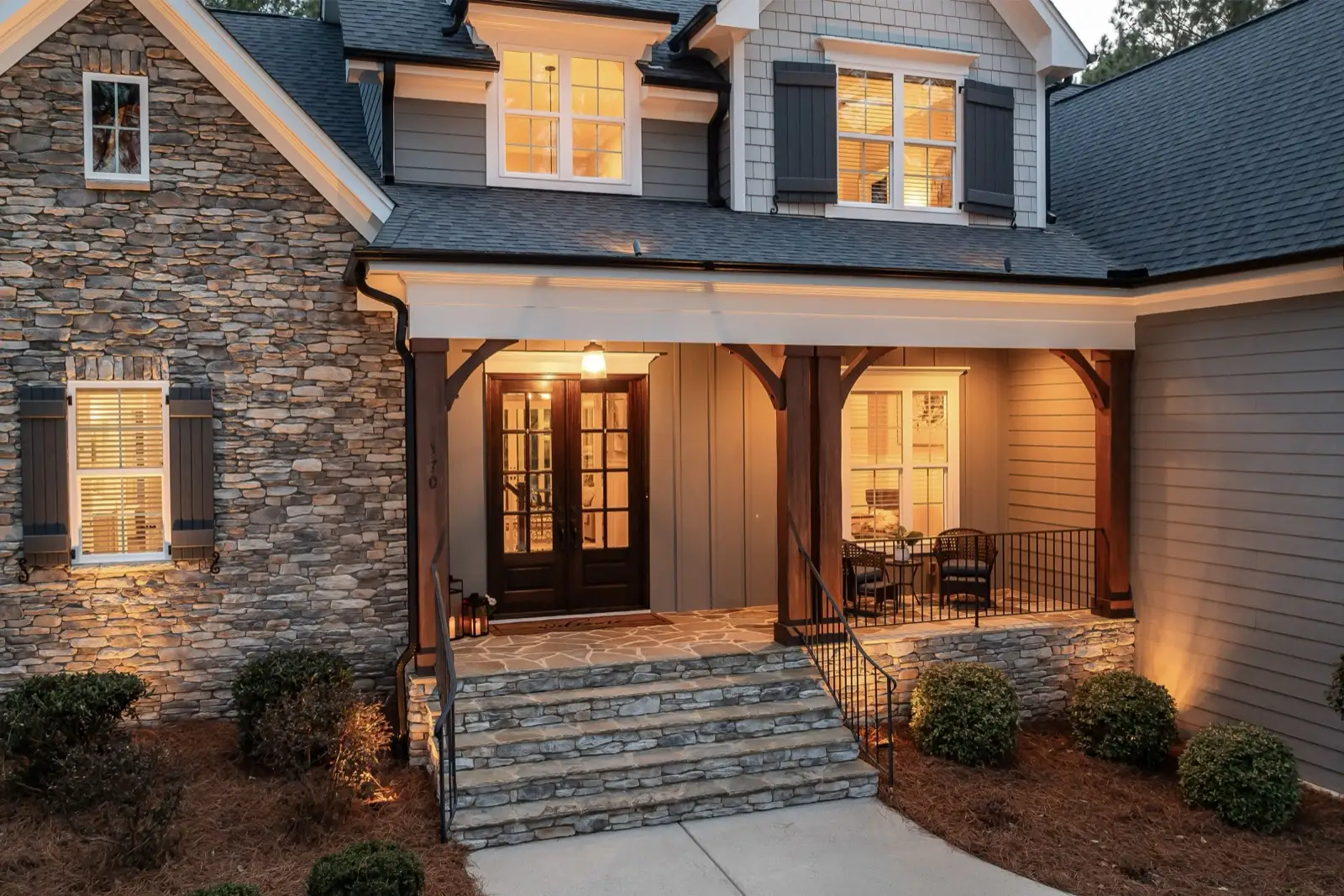
The landscape lighting ideas that suit Middle Tennessee homes start from what the property already has. That usually means brick or stone to graze, mature oaks and hickories to uplight or moonlight from, paths and steps to mark, and planting that looks best under warm 2700 to 3000K light. Then you decide which parts of the yard stay dark.
The dark is where most yards go wrong. Put a spotlight on every shrub and the yard looks busy. A handful of fixtures with dark gaps left on purpose between them is what makes it look designed. Restraint is a budget point too. A Gemmell install runs $250 to $350 per installed fixture, so a fixture left out of the plan is money kept, not a gap in the design. Few homes need every one of these landscape lighting ideas. We treat them as parts of landscape lighting designed as one system and pick the three or four a property actually calls for.
Which walls are worth grazing?
Fieldstone, rough-cut limestone and older brick with deep mortar lines are the best candidates, and plenty of houses around Franklin and Nashville are built from exactly that. Grazing puts a fixture close to the base of a wall and aims it straight up, so the beam rakes across the surface instead of hitting it head-on.
Every mortar joint and every bump in the stone throws a small shadow, and those shadows are what read as texture after dark. Move the same fixture out into the lawn and point it at the house and the texture disappears, and the wall goes flat and pale. Architectural lighting for the facade is planned as its own layer, because the angles and spacing are different work from the garden.
When a wash beats a graze
Smooth stucco, painted brick and fiber-cement siding give a raking beam nothing to catch. Grazing those surfaces mostly shows up every wave and patch in the finish. A softer wash from a few feet back suits them better.
How many lights does a big oak need?
A young tree often takes a single uplight. A broad, mature oak or hickory usually doesn’t. Lit from one side, a wide crown shows up as a bright slice with a black back half, which looks more like an accident than a choice.
Lighting it from two or more points around the trunk fills the canopy and turns the tree into a backdrop for the whole yard.
Which trees get lit matters more than how many. Two or three specimen trees, the ones with real form or a spot near the house, usually carry the canopy layer while the rest stay dark. Garden and tree lighting covers how fixture count and angle change with height and crown shape, and the best lights for uplighting trees goes into the fixtures themselves.
Which trees can carry moonlighting?
Moonlighting turns the uplight around. The fixture is mounted high in the tree and aimed down, and the leaves and limbs break the beam into dappled shadow on the lawn or patio underneath. It needs height and an open branch structure.
A tight ornamental or a young tree won’t filter the light, and the fixture ends up as a floodlight on a stick.
Something most idea lists skip: the hardwoods that suit moonlighting best are deciduous, so the effect changes with the season. In summer the canopy softens the light into moving patches. From late fall through early spring the bare limbs cast sharp branch shadows across the ground, a different look but not a worse one, and the same bare winter crown is when uplighting shows off a tree’s structure. The wire runs up the trunk to the fixture, so the mounting has to leave room for the tree to keep growing.
How should a back path or side yard be lit?
A path needs enough light to show where its edges are, not an even glow from end to end. Set low fixtures so each one throws a pool of light that just meets or falls slightly short of the next.
Stagger them from side to side rather than pairing them, and tuck them back into the planting so you see the light on the ground before you see the fixture. Matched posts at even intervals down both sides are what give a path the airport-runway look. Stepping-stone routes through a bed and the side yard to the gate are where this matters most, because those are the routes people actually use at night. Pathway and driveway lighting covers spacing on curved and straight runs. For the walk and drive at the front, see outdoor lighting ideas for the front of a house.
What about steps, walls and the patio?
Hardscape gets its own layer, separate from the planting. Step lights set into the riser, or low on the wall beside the stairs, mark the edge of each tread so a change in level shows after dark. Low lights in a seat wall, a patio edge or a pergola post keep a seating area usable once the sun goes down.
They do that without dropping a bright light over the table. Of everything in this post, the step light is the one with a safety reason behind it, and it is worth doing even if nothing else gets lit. Hardscape lighting goes into step, wall and patio fixtures, including where they meet a pool or an outdoor kitchen.
Can garden beds and water be lit too?
Yes, with a lighter hand than anywhere else. Flood a bed and the leaf texture that made it worth lighting washes out. A low, spread light across the front of a bed, or one fixture on a single plant with strong structure, does more.
Phil spent more than a decade designing and building outdoor spaces before he specialized in lighting, and choosing what to light in a bed is a planting question as much as a lighting one. Evergreens such as boxwood and holly hold their shape through winter, while most perennials die back, so a bed lit around its perennials can look empty for months.
Water is its own case. A submersible light in a fountain basin lights the moving water from inside, which is usually the point. A still pond often looks better with the light kept out of the water and aimed at a tree or wall on the far bank, so the surface carries a reflection instead of a hot spot.
What color and fixtures hold up here?
Every system we design runs 2700 to 3000K. That warm range flatters brick, limestone, cedar and green planting. Cooler whites pull the color out of all four and leave a facade looking gray. Glare is the other whole-property decision: hood or shield each fixture so the lamp itself isn’t visible from the patio, the windows or the street.
Aim each one too, because glare catches uplights as much as anything. The light should land on the tree or the wall, not in a guest’s eyes or a driver’s windshield. Downlights on a wall or in a tree can go further with fully shielded fixtures that send nothing sideways.
Fixture material shows up over years, not on install day. We spec solid brass and copper over painted aluminum, because Middle Tennessee humidity and freeze-thaw cycles punish any coating. Brass and copper age to a patina instead of flaking. The free design walk is done at dusk, so these calls get made in real light rather than on a plan.
Common questions
What is moonlighting in landscape lighting?
Moonlighting mounts a fixture high in a mature tree and aims it down through the branches, instead of up into the canopy from the ground. The leaves and limbs break the beam into dappled shadow on the lawn or patio below, which looks far closer to moonlight than a single downlight on a pole.
It needs a tall tree with an open branch structure. A young or dense ornamental won’t give the effect.
Can landscape lighting work in a small yard?
Yes. A small yard needs fewer fixtures placed well, not a shrunken copy of a large system. One tree lit properly, low lights along the route people actually walk, and darkness everywhere else is often enough. Crowd a small yard with fixtures and you lose the depth that two or three well-aimed lights would have given it.
A design walk at dusk is the easiest way to size the plan to the yard.
How do you light a brick facade without making it look flat?
Set the fixture close to the base of the wall and aim it up, so the beam rakes across the brick instead of hitting it straight on from the lawn. The raking light catches the mortar joints and throws small shadows across the surface, and that is what reads as texture at night.
A head-on flood does the opposite and turns the wall into a flat, pale sheet. Smooth or painted brick suits a softer wash from farther back.
Should every tree in the yard be lit?
No. Light every tree and the yard loses the dark that makes a lit tree stand out. Two or three specimen trees, picked for their form or their place near the house, usually carry the canopy layer while the rest stay in shadow. It also keeps the budget in check.
At Gemmell’s installed rate of $250 to $350 per fixture, each tree left dark saves at least one fixture, and a broad oak often takes two or more.