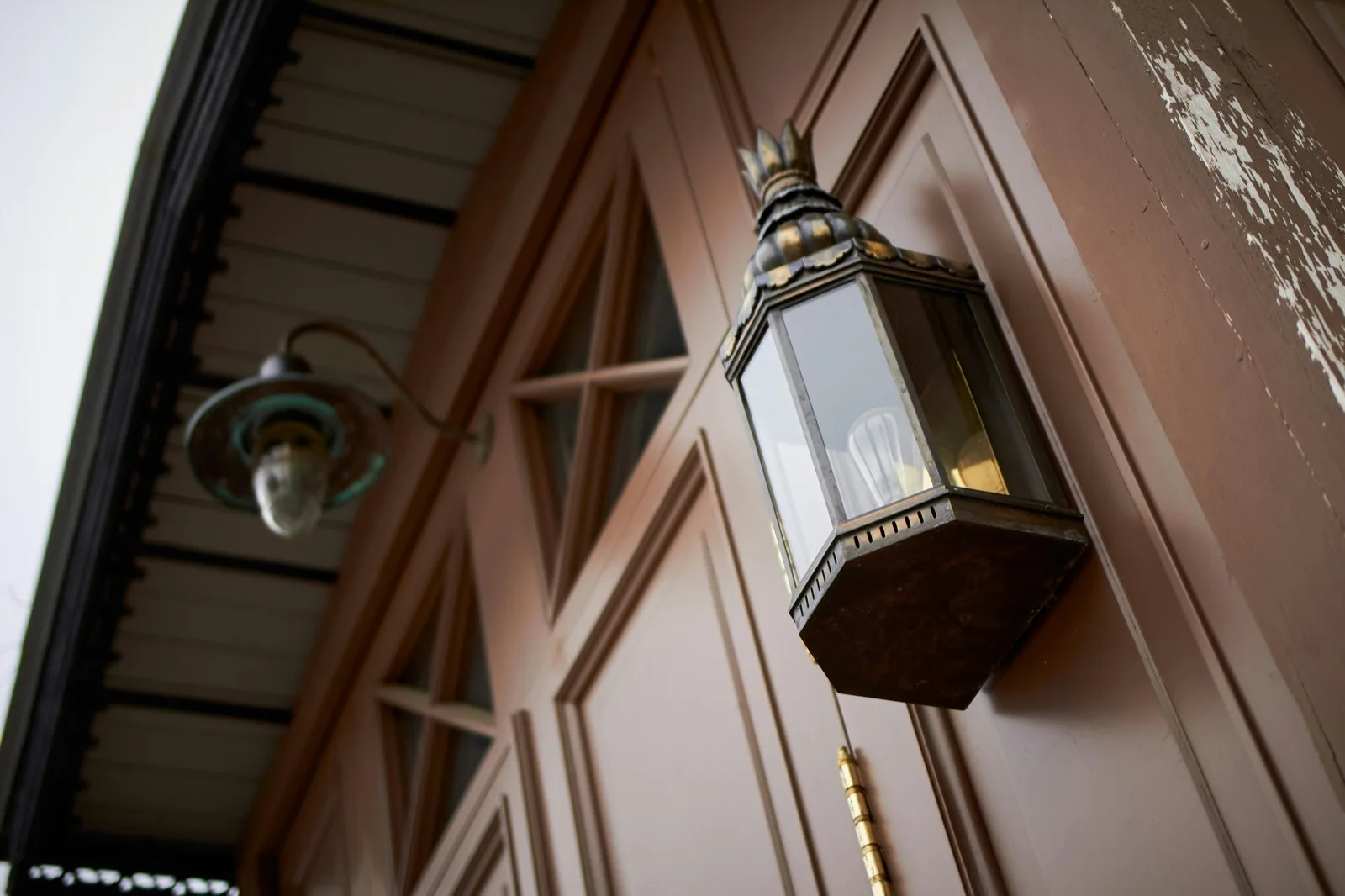
Most outdoor lighting repair comes down to five faults: a failed transformer, a corroded connection, cut cable, water inside a fixture, or a worn-out fixture. The price depends less on which one it is than on how long the fault takes to find, how hard it is to reach, and how many connections need re-making.
Which five faults are behind most repair calls?
The list comes from our landscape lighting repair around Nashville, where the faults we see most are failed transformers, corroded connections, cut cable, water ingress and fixtures at end of life. The same five show up on wall lanterns, post lights and permanent rooflines, which is why they all sit under one service, outdoor lighting maintenance and repair.
What changes between fixture types is which fault turns up first.
Each one also tends to leave its own pattern, and the pattern tells you where the tracing should start.
- A whole run goes dark at once, or every fixture on it flickers together. Suspect the transformer feeding it before any single light.
- One fixture dims or flickers but never quite goes out. A corroded splice will still pass some current, so the light limps along instead of dying.
- A section goes dark past a certain point, often not long after an edger, an aerator or a new planting bed went through. That is usually cut cable.
- A light drops out after heavy rain and comes back once things dry. Water is getting in through a cracked lens, a tired gasket or a socket that was never sealed.
- The lens is clouded, the housing is corroded or the socket won’t hold a lamp firmly. That fixture is at end of life, and no repair changes it.
If it’s only landscape lights and only some of them, our checklist for when some landscape lights aren’t working covers the safe checks to run before booking anyone.
Why do wall lanterns, post lights and rooflines fail differently?
Where a fixture sits decides what wears it out. Buried landscape fixtures live at soil level, next to mulch, irrigation and every shovel, so their trouble skews toward wet splices and cut cable. Wall lanterns and post lights sit up in the weather all year, so gaskets and sockets give out first.
Sideways rain and summer sun also age the finish. That’s one reason we spec solid brass and copper over painted aluminum, because Middle Tennessee humidity and freeze-thaw cycles punish any coating.
A permanent outdoor lighting system is the odd one out. Its LEDs are rated for 25,000 to 50,000 hours, so the light source burning out should be the least likely of the five. The weak points are the ones it shares with everything else outdoors: the joins between sections, the equipment that powers and controls the run, and any seam at a gutter or trim board where water can track in. We service any brand, including Trimlight, JellyFish and Gemstone systems installed by others, so a roofline repair doesn’t depend on getting the original installer back.
Patch or re-make: why does the connection matter so much?
Because a patch tends to fail again in the same spot. A patched splice, meaning tape wound around a wire nut or an old connector pushed back together, usually lights up the same afternoon, then goes dark again, often after the next long wet spell.
The tape breaks down in the soil, the nut works loose as the ground heaves through freeze and thaw, and water finds its way back along the same path.
We re-make failed joints with properly rated waterproof connectors instead of patching them. The point is a joint that keeps water out as well as the cable jacket on either side does, so the repair doesn’t become the run’s next weak spot.
This is also how a repair quote can grow once someone is inside the wiring. One dark fixture might be one bad joint. It can just as easily be the first of several joints on that run that were patched the same way years back and are now failing on roughly the same timetable.
What drives the cost of an outdoor lighting repair?
We don’t publish a repair price. The fault has to be found before anyone can price fixing it, so the repair gets quoted after the system is tested, not from a symptom described over the phone.
Once the fault is known, four things move the number. Finding it is the least predictable. A dead section might be one bad splice at the first fixture or a nick in the cable three fixtures upstream, and tracing that takes time whether the run is buried, on a wall or clipped along a roofline. Then access, since a buried splice means hand-digging around roots and irrigation while a roofline join means ladder or lift work. Then parts, because replacing a solid brass fixture is a different purchase from replacing a painted aluminum one. Last, and often biggest, is how many connections need re-making. A run with one failed joint costs less to put right than a run where the same old patching is failing in five places.
Our page on lighting repair in Green Hills shows that tracing on older systems with severed runs and mixed-era fixtures. We cover homes within about 30 minutes of Franklin.
When does replacing beat repairing?
An outdoor lighting repair makes sense when the wiring, a connection or the transformer is at fault and the fixture itself is sound. Once the fixture itself has failed, repairing it just pays to put off a replacement you’ll be buying anyway.
Failed here means the housing has corroded through, the lens has clouded past giving an even beam, or the socket won’t hold a connection however well it’s cleaned.
Material shifts that line. A solid brass or copper fixture usually has more life worth protecting than a painted aluminum one whose coating has started to go. On a permanent roofline, the rated LED life is a useful yardstick. Run six hours a night, every night, 25,000 hours is a little over eleven years and 50,000 is closer to twenty-three, so a young system that’s partly dark almost always has a connection or power fault, not worn-out LEDs.
Before weighing a repair estimate on an old fixture, have a replacement figure in mind. On our outdoor lighting costs in Nashville page, national cost guides put professionally installed fixtures at roughly $150 to $350 each, and our own installed brass and copper fixtures run $250 to $350 each.
If we installed the system, our workmanship warranty covers the wiring, connections, fixture mounting and transformer programming. Full terms and duration are confirmed at the design walk.
For how Middle Tennessee’s seasons wear a system down year by year, see what Tennessee weather breaks in landscape lighting.
Common questions
Can halogen fixtures be converted to LED?
Often, though it depends on the fixture. Many housings take an LED retrofit lamp in the existing socket, which is the simplest route. Fixtures with a reflector or lens shaped around a halogen bulb’s size and heat don’t always give a good beam with a swapped lamp, and replacing the whole fixture can be the better call there.
Testing the fixture in place usually settles which route makes sense.
Can a failing transformer damage the fixtures on it?
It can. A transformer that is failing may send too much or too little voltage down the run, which shortens lamp and LED life and can make every fixture on that circuit flicker, not just one. Failed transformers are among the faults we see most.
That’s why checking a transformer’s actual output is one of the first steps when a run isn’t behaving.
Does homeowners insurance cover storm-damaged outdoor lighting?
That depends on your policy and on what caused the damage, so ask your insurer or agent before assuming either way. Sudden damage, like a falling limb, is treated differently by most policies from gradual wear, corrosion or a fixture that was already failing before the storm.
Photos taken before anything is cleared away, and any broken parts you keep, make that conversation easier.
How often should outdoor lighting be serviced?
No single schedule fits every system, but a seasonal look catches most problems before they turn into an outage. That means checking connections you can see, pulling mulch and new growth back from fixtures, and making sure the timer or photocell still switches on at the right time.
Older systems, and anything that has just come through a hard winter, deserve a closer look in spring.