

Architectural Outdoor Lighting
Williamson County, Tennessee
Architectural lighting uses precisely placed exterior fixtures to reveal a home's structural character after dark — rooflines, columns, stone facades, and material texture that daylight takes for granted. Gemmell Outdoor Lighting designs custom architectural systems for homes in Franklin, Brentwood, and Williamson County, Tennessee. Free design walk. Call (615) 914-4411.
Your Home's Architecture Deserves to Be Seen
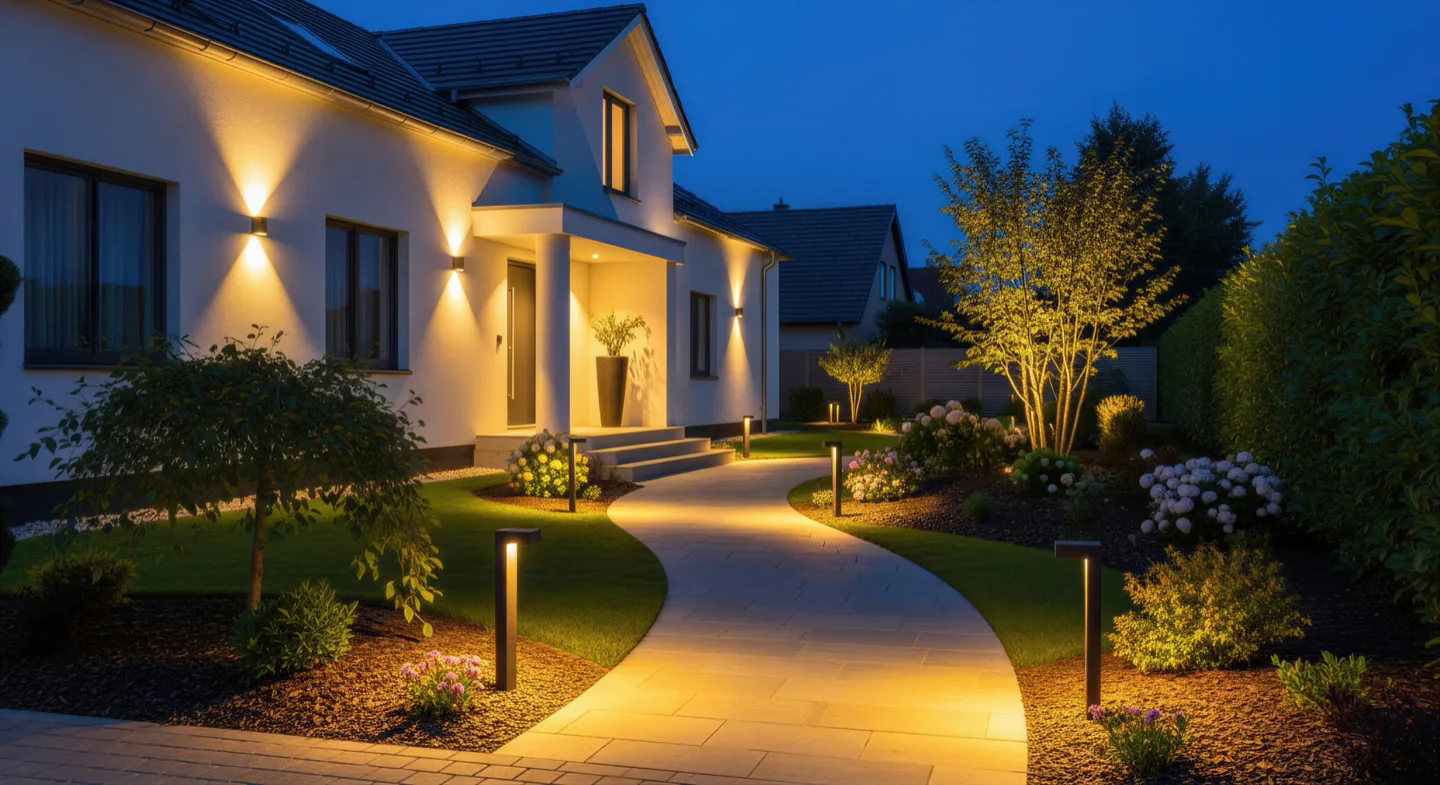
Architectural lighting is the difference between a house that goes dark after 5 pm and one that becomes a landmark. Every facade has angles, textures, and features worth revealing — the right uplight in the right position can make a brick gable read like a gallery wall.
Phil begins every architectural lighting project by studying your home's specific profile — the materials, the rooflines, the column spacing, the mature trees flanking the facade. Then he places each fixture to reveal those features rather than simply illuminate them. The result is intentional: your home looks like it was designed to be seen at night.
For lighting driven by the landscape rather than the facade, see our landscape lighting design process.

Every Architectural Feature Has a Lighting Technique
Facade Uplighting
Ground-mounted fixtures wash your home's face in warm light, creating depth from the contrast between illuminated material and shadowed relief.
Column & Pillar Accents
Grazing light down columns and pillars reveals their texture and scale — the detail your architect intended that disappears in flat light.
Gable & Roofline Wash
Angled uplighting on gables adds vertical scale and draws the eye upward — making even a single-story home read with commanding presence.
Tree Uplighting
Well-placed uplights in the root zone of mature trees create a backdrop for your home — the tree frames the facade rather than hiding it.
Entrance Illumination
Your front door is the focal point of your home's face. Balanced light from both sides, at the right intensity, creates a welcoming arrival without glare.
Driveway Approach
The reveal of your home as a guest turns into your driveway is a design opportunity — one that begins 40 feet before they reach the front door.
Architectural Lighting Services
- Facade and elevation uplighting
- Column, pillar, and entryway accents
- Gable and roofline wash lighting
- Tree and landscape feature uplighting
- Perimeter and security lighting integration
- Driveway approach and entry illumination
- Cove and soffit accent lighting
- Smart timer and dusk-to-dawn controls
- Low-voltage and energy-efficient LED specification
- Nighttime aiming and beam calibration
- Seasonal profile adjustment
- Integration with permanent roofline fixtures
"Always a pleasure working with Phil and his team. Top notch workmanship and very professional, would highly recommend."
— D. Reid, a client of Phil’s previous business
Pair With Our Other Services
Questions, Answered
What color temperature is best for architectural lighting?
Warm white, 2700K to 3000K, on brick, stone and painted wood alike. The reason is the material it lands on. Cooler light drains the red out of aged brick and leaves limestone looking grey and institutional, while a warm source flatters what the mason laid.
It is also the one decision on a plan you cannot revisit later without buying new fixtures, so it gets settled on the walk.
What is architectural lighting for homes?
It lights the building instead of the garden: the columns, the gable ends, the roofline, the surround at the front door. The fixtures sit at fixed angles and wash or graze the surface so brick and stone show their texture after dark.
On most properties it gets drawn at the same time as the landscape lighting and held to the same warm white, since a facade glowing above a black garden looks half-done.