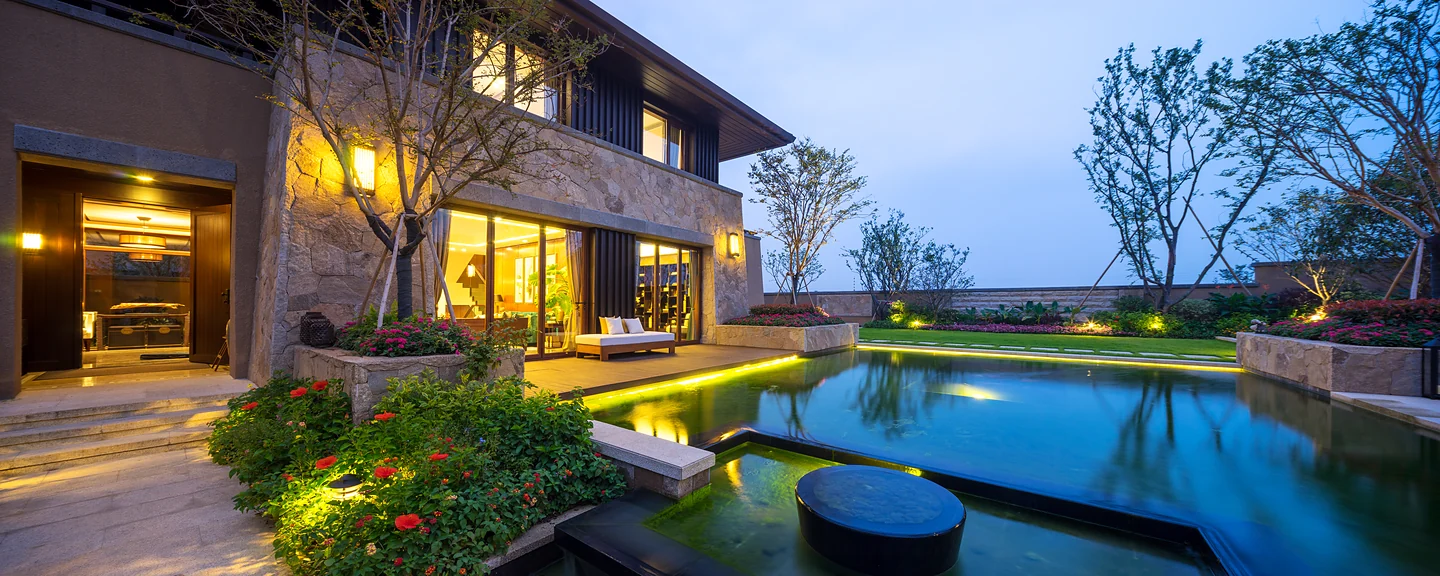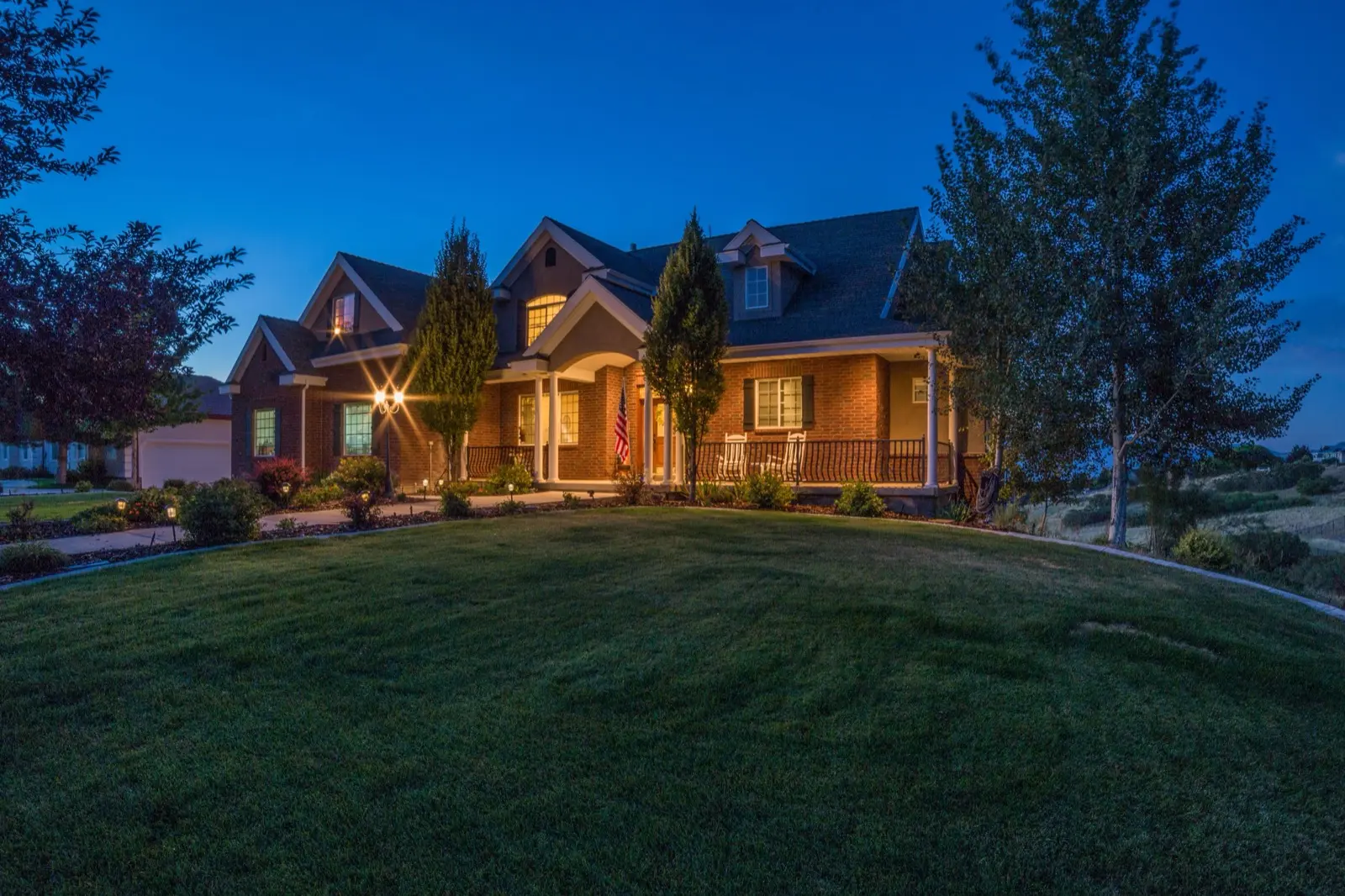
When you sort through outdoor lighting ideas for front of house curb appeal, work from the curb toward the door. Four pay off most: a walk and drive you can follow without seeing the fixtures, one facade feature grazed so its brick or stone shows, an evenly lit entry, and house numbers with a light of their own.
What should you light first on the front of a house?
Pick one lead feature, usually the facade or a pair of trees framing it, and let the walk, the entry and the numbers play support. The front elevation is worth planning as one picture instead of a set of separate fixtures.
It gets seen by headlights, by a neighbor out walking and by the delivery driver long before anyone reaches the door. Put five different techniques on one elevation and the house just looks busy.
Two techniques carry most facades. A wall wash sets the fixture back from the surface so the light lands even and flat. Grazing moves it in close, and the beam rakes across the wall and throws every mortar joint and stone edge into relief, which is what brick and stone are asking for. A lit facade over a black lawn looks unfinished, so architectural lighting for the facade is planned together with the rest of the front yard and held to the same warm white.
Trees that frame the front
A mature tree beside a two-story front gives the house a backdrop at night where there would otherwise be a bare wall and a dark roofline. The uplight goes out from the trunk, not jammed against the bark, so the beam reaches up into the canopy. One well-lit tree often does more for the whole front than a second facade fixture would. Trees and beds farther from the street are covered in the broader landscape lighting ideas post.
How should the walk and driveway be lit?
By the shape of the walk, not by a tape measure. Spacing tightens where there is a turn or a step to flag and opens up along a straight run where nothing needs pointing out. Evenly spaced fixtures lined down both sides give you the runway look, and a house lit that way starts to resemble a hotel entrance.
From the street you want to see pools of light on the paving. The fixtures sit just off the edge, in the bed, where nobody trips over them or clips them with a mower.
The driveway is a separate job with a plainer purpose, which is getting a guest from a parked car to the front door without watching their feet. That is why pathway and driveway lighting is laid out as its own layer under the facade and entry, with its own spacing.
How bright should the front door and porch be?
Bright enough to see a face clearly, and no brighter. The entry is the one spot on the front where lighting has a job beyond looks, because somebody stands there, close up, waiting. Light from both sides of the door at a moderate level handles that.
A single hot fixture at eye height does the opposite: the visitor squints, and whoever opens the door is looking at a silhouette.
Most porches already have something, whether it is a ceiling fixture or a pair of sconces. When they do, the better addition is usually low light at the columns, which adds depth without doubling the brightness at the door. A covered porch also changes things. The ceiling fixture already throws light down and out toward the steps, so adding another source aimed at the door mostly just adds glare.
Columns, stone and brick
Columns are about the easiest win on a front elevation. A fixture set close at the base and grazed up the shaft picks out fluting, stone coursing or brick texture that daylight and porch light both flatten. The same goes for a chimney breast, a stacked-stone planter wall or a brick water table. Pick one or two of them. Once every piece of masonry on the front is lit, none of it stands out anymore.
Front fixtures get looked at up close in daylight for years. We spec solid brass and copper over painted aluminum, because Middle Tennessee humidity and freeze-thaw cycles punish any coating.
House numbers you can read at night
This is the one most front-yard plans skip, and you notice it the first time a guest or a driver stops at the curb and squints. Spill from a porch light rarely reaches the numbers at a readable level. A small, shielded fixture aimed straight at them does. Numbers on a mailbox post or a low wall by the street are a separate problem, since that is where the driver is actually looking, and they need a source of their own out there instead of borrowed light from the house.
Balance, not brightness
Front yards rarely go wrong from too little light. They go wrong from too much in the wrong place: a floodlight over the garage that flattens everything around it, an entry bright enough to erase the columns beside it, a facade wash that fights the porch. What works is several modest sources in layers (walk, entry, facade, numbers), each aimed so the light lands on a surface and not in a neighbor’s window or the night sky. That shielded, downward approach is also what dark-sky-friendly outdoor lighting looks like in practice.
Color is the other half of it. Every system we design runs 2700–3000K, and keeping the whole front at one temperature is what stops it looking like a patchwork of different whites. The quickest way to break that is a cool off-the-shelf security light over the garage next to warm path lights. More on choosing color temperature and beam spread is on the landscape lighting design page, and if you are working through a full plan in order, the guide to how to design landscape lighting takes it step by step.
It also helps to wire the front as its own zone. Then it can come on at dusk and step down later in the evening without touching the backyard. The last step happens after dark. On the final walkthrough Phil tests every circuit and adjusts anything that isn’t exactly right, and on the front of a house that usually means nudging an aim a few degrees until the glare is gone.
Common questions
Should front porch lights stay on all night?
Often only part of it does. Most front-of-house systems run on a dusk-to-dawn photocell or a timer, so nobody has to remember a switch, and a common setup keeps the walk, the entry and the house numbers on all night while the facade and trees turn off at a set hour.
That is easy when the front is wired as its own zone, which gets settled during design.
How many lights does a front yard need?
The count comes from how wide the front elevation is, how many features are worth lighting, and the shape of the walk and drive, so it gets settled on a free design walk at dusk, when Phil can see the property in real light. For budgeting, Gemmell’s own rate is $250 to $350 per installed fixture.
National cost guides put the market range at roughly $150 to $350 per fixture.
Do uplights on porch columns look good?
Yes, when the beam grazes the column instead of washing it flat. A fixture set close at the base and aimed up the shaft brings out fluting, stone coursing or brick texture, and it gives the column more presence than daylight does. Columns look best as one accent among a few.
Uplighting every column and post on the front at once tends to look busy.
How do you light house numbers so they can be read at night?
Give them their own small, shielded fixture aimed straight at them, rather than hoping porch light spills far enough. Numbers on a mailbox post or a low wall by the street need a source right there, since that is where a driver looks.
Run it at the same warm white as the rest of the front so the address reads easily without becoming the brightest thing on the house.