A 150-foot roofline at the national market rate of $25 to $35 per installed foot comes to $3,750 to $5,250. Measured feet times a per-foot rate is how a permanent Christmas lights cost estimate gets built, and the square footage of the house barely enters into it. Those are national figures, not a Gemmell quote.
How is a roofline measured for permanent lights?
Someone walks the outside of the house and follows every edge the lights will run along. That means the front eave, the sides and back, the sloped edges of each gable, and every place the roof steps up, turns a corner or wraps over a garage.
Add those up and you have the one number the rest of the price hangs on.
You can get close on your own. On a simple hip roof the eave line is roughly the perimeter of the footprint, plus a little at each corner for the overhang, so a ranch about 45 by 30 feet comes to around 150 feet. Gables are where a tape measure on the ground stops working, because the lights follow the slope and not the wall below it. That is also why a quote over the phone is close to worthless. Two houses with the same square footage can carry very different rooflines. Our permanent outdoor lighting cost page has the market range and the other things that move a quote. For an actual number, Phil walks every property himself on a free design walk, and the written quote comes after that.
Why do peaks, dormers and a second story cost more?
Gables add real footage, because the lights run up one sloped edge and down the other and a sloped edge is always longer than the wall under it. Over a 30-foot gable wall, a moderate 6/12 pitch gives about 33 feet of sloped edge before the overhang is counted.
A steep 12/12 pitch gives about 42 feet, roughly 40 percent more than the wall itself. So a front elevation with three or four steep gables can carry more footage than a longer hip roof on a bigger house.
Dormers mostly add labor instead. A small dormer adds only a few feet of lighting, but every place a run stops, turns or starts again is a termination, and terminations eat material and ladder time out of proportion to their length. Returns, where the eave wraps a corner and ends, count the same way. A second story adds both at once: there is more roofline to follow, and the upper eave usually can’t be reached from the ground, so the job needs a taller ladder or a lift. That access cost is part of the price on any exterior lighting job.
Detached buildings are a separate choice. A garage or pool house adds real footage if it’s included, so it is worth deciding at the walk whether it’s in, rather than halfway through the quote.
Worked examples: three rooflines at the national rate
Every figure below is the national $25 to $35 per-foot range multiplied out, so read them as a picture of how permanent Christmas lights cost scales with footage, not as Gemmell prices.
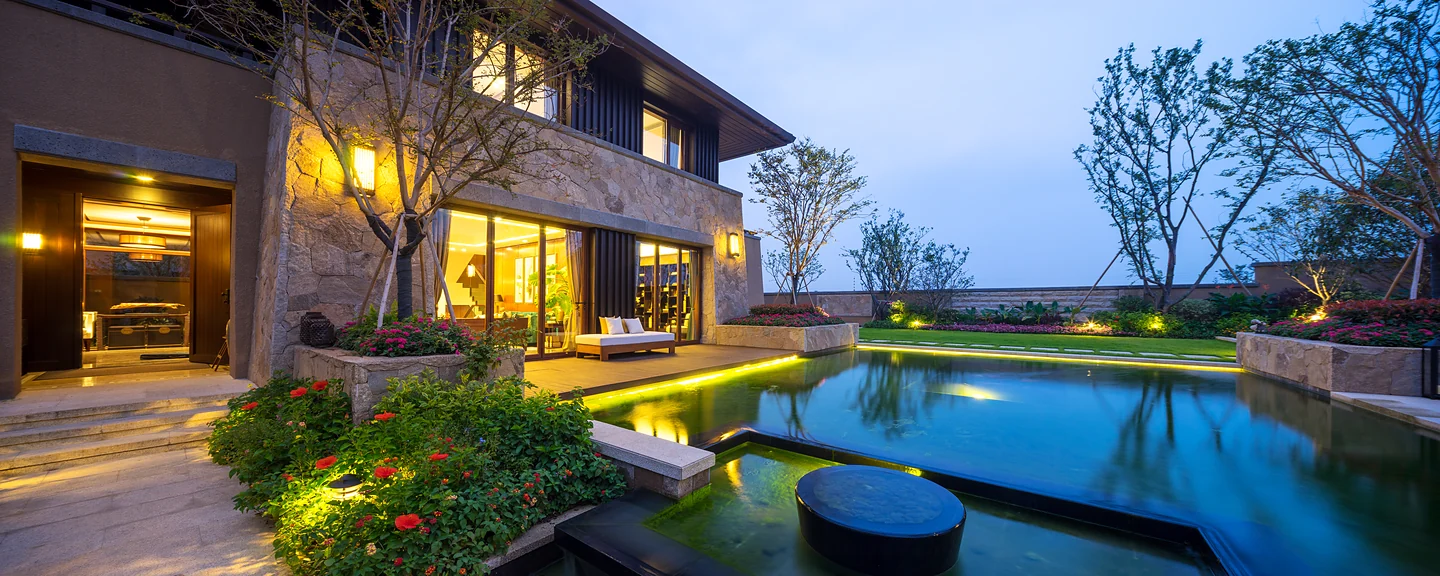
A 150-foot ranch like the one at the top of this page, lit on all four sides, comes to $3,750 to $5,250. A two-story house with two front gables and a longer front elevation might run to 220 feet, which is $5,500 to $7,700. Add dormers, several roof planes and a detached garage and the total could reach 320 feet, which takes the same math to $8,000 to $11,200. That is still inside the national range of $3,000 to $12,000-plus for a whole-home system, and the only input that moved between the smallest house and the largest was footage, which went from 150 to 320 and took the total up by the same factor of a little over two.
Landscape lighting is priced differently, per fixture rather than per foot, and our outdoor lighting cost guide for Nashville covers that side, including Gemmell’s own $250 to $350 per installed fixture.
What do the controller and power add?
The track and lights are half the system. The other half is a controller that runs the whole length, and a power source close enough to reach it without an extension cord strung across the porch. If there is already an outdoor outlet near the roofline, that part is simple.
If there isn’t, new power has to be run to it, which is real work and belongs in the written quote from the start.
The controller is also what makes these more than Christmas lights. It runs warm white on an ordinary Tuesday and a holiday palette in December, from an app instead of a wall switch. The permanent outdoor lighting page explains how the track, lights and controller fit together. Some installers list the controller as its own line and some fold it into the per-foot figure, so ask which. Power is the other thing that can pull an early estimate and the final quote apart, for example when a detached garage sits well away from the electrical panel. It’s a question for the walk, not for after.
What does a boxed kit leave out?
A boxed permanent-style kit from a home improvement store is a real option. You buy the parts, mount them yourself and plug them into an outlet or a smart plug.
What a kit leaves to you is the roofline measurement, working out the mounting for your particular eave and gutter, planning the controller and power as one job, any warranty on the labor, and finding someone to call when a run goes dark in February. The service question deserves the most thought. On landscape systems, corroded connections and water ingress are among the faults Gemmell sees most, and Middle Tennessee’s humidity and freeze-thaw cycles are hard on outdoor hardware. A roofline run has connections too. On a kit, sealing them is your job.
If a brand installer already put a system on your house, Gemmell isn’t a Trimlight or JellyFish dealer and services those brands, Gemstone too, when someone else installed them. And if you are still deciding whether permanent lights suit your house at all, our post on whether permanent Christmas lights are worth it covers that question before price. Hiring a seasonal install each year may be the better fit for now. The Christmas light installation cost breakdown shows what goes into that yearly number, and Christmas light installation is the service itself.
Common questions
Do permanent Christmas lights cost more on a two-story house?
Usually, yes, though the second story isn’t the charge on its own. The extra roofline and the access are. A two-story house has more edge to follow, and steep upper gables add sloped footage that runs longer than the walls below them. Reaching an upper eave also usually takes a taller ladder or a lift.
Both push the total up at the same per-foot rate.
Is a boxed permanent light kit cheaper than an installed system?
Up front, yes. With a kit you are buying parts, not a measured, designed and warrantied install. What you give up is the roofline measurement, mounting worked out for your eave and gutter, a controller and power run planned as one job, and someone accountable when a section fails.
Whether that trade is worth it depends on how comfortable you are on a ladder and with fixing the system yourself.
Does the controller or app cost extra?
The controller and its app aren’t optional parts. They are how the same lights switch between everyday warm white and holiday colors. Some installers list the controller as its own line, while others fold it into the per-foot figure. Either way is fine as long as the written quote says which, so ask before you sign.
Can I light only the front of the house to start?
Yes, if it’s planned that way. For a later addition to work, the run should stop at a natural break, such as a corner or a roof return, and the controller and power should be placed so the sides and back can be added without redoing the front.
The front is the side people see, and starting there keeps the first phase smaller. A run that stops partway along a wall looks unfinished.